terça-feira, 17 de agosto de 2021

Mexico is phasing out glyphosate and GMO corn


President López Obrador’s decree could forge the “hope at home” U.S. officials espouse.

Renée Alexander & Simran Sethi

19th July, 2021

Last month, on her first international trip as Vice President, Kamala Harris offered a blunt message to Mexican and Central American migrants considering “the dangerous trek” to the United States: “Do not come.” Rather than quell waves of migration through punitive measures at the border, she said, the Biden administration would encourage people to remain in their own countries by focusing on programs that provide “hope at home.” 

The administration’s idea (at least in theory) is to focus on root causes for the departure, rather than crack down on those who are vulnerable—or desperate—enough to risk the journey. But any attempt at genuine reform will need to weigh the impact of U.S. trade policies on poverty abroad, particularly relating to food and agriculture. 

Mexico is now the United States’ single largest agricultural trading partner, largely the result of the North American Free Trade Agreement (NAFTA), a treaty enacted in 1994 that eliminated tariffs on the majority of goods produced and traded between the United States, Mexico, and Canada. Although NAFTA was heralded by the U.S. government for reducing barriers to trade, as The Counter previously reported, the pact devastated rural economies in Mexico, flooding the market with cheap, government-subsidized U.S. corn and gutting domestic corn prices by nearly 70 percent. This shift led an estimated 2 million farmworkers to abandon the countryside to seek work in big cities or across the border in the United States. 

The United States-Mexico-Canada Agreement (USMCA)—the replacement for NAFTA that entered into force in 2020—further entrenched this challenge. Touted by then-U.S. Secretary of Agriculture Sonny Perdue as a “better deal for America’s farmers, consumers, and workers that will set them up for success for decades to come,” USMCA has done little to benefit Mexico’s small and subsistence farmers or stem the flow of migration that dropped during the height of the pandemic but is, again, increasing. New data released on Friday by U.S. Customs and Border Protection showed that June was the highest month for new arrivals at the southern border since President Biden took office.     


Now, days out from the expiration of the latest ban on non-essential travel between the U.S. and Mexico, it is unclear how the Biden administration intends to reckon with this legacy. But if our southern neighbors seek “hope at home,” they may find it in the form of policy changes cultivated within Mexico itself. 

On December 31, 2020, Mexican President Andrés Manuel López Obrador signed a decree that could enable Mexican farmers to reclaim their livelihoods within their home country. The order calls for the phase-out by 2024 of two pillars of American agribusiness: glyphosate and genetically engineered (GE) corn, particularly corn grain consumed as part of “the diet of Mexican women and men.” 

Glyphosate is an herbicide sprayed on corn and other crops that have been genetically engineered to tolerate its plant-killing properties. It is the active ingredient in Roundup, a flagship product of the company formerly known as Monsanto, that, in 2018, was acquired and fully absorbed by the German chemical company Bayer.

López Obrador’s decree was created with the explicit goals of rebuilding self-sufficiency and reclaiming food sovereignty, efforts that eroded under NAFTA due to a requirement that Mexico open its markets to U.S. corn. Mexico now purchases 25 percent of American corn exports, amounting to more than $2.7 billion annually. Nearly all of the 16 million tons of corn Mexico imports each year is used for livestock and industrial purposes, while corn for human consumption is grown domestically. Nevertheless, the imports represent one-third of Mexico’s overall demand for corn. 

Because of how the decree was phrased, it remains unclear whether GE corn for animal feed will be subject to the eventual ban. While Mexico’s Agriculture Secretary Victor Villalobos Arambula has assured U.S Secretary of Agriculture Tom Vilsack that only grain for human food products will be affected, the vaguely-worded decree is subject to interpretation by the government ministries of Agriculture, Health, and Environment as well as CONACyT, the National Council of Science and Technology. The latter three of these four parties are more closely aligned with Deputy Minister for Agriculture Víctor Suárez, an agronomist and key architect of the decree, who advocates for banning all GE corn imports.

Although the task is formidable, the phased prohibition could transform the multibillion-dollar grains trade between the United States and Mexico, and increase local farmers’ market share within Mexico. But in order to replace these imports, Mexican farmers would need to increase domestic production by nearly 60 percent, a goal dismissed as unrealistic by critics of the policy. Suárez acknowledged the daunting challenge in February, when he said, “Say we don’t reach the goal of substituting the 16 million tons [of imports], and we only reach the substitution of 10 million. Well, we would evaluate that along the way and…make the necessary adjustment …. We have to put the right to life, the right to health, the right to a healthy environment ahead of…business.”

This executive order not only advances a core commitment López Obrador made in his inaugural speech in 2018 around achieving self-sufficiency in grains. It builds on more than a decade of grassroots resistance against an earlier government decision to allow permits for GE corn cultivation, including the 2013 efforts of a coalition of Mexican social and environmental justice advocates, smallholder farmers, beekeepers, and scientists who filed a class-action lawsuit to halt further permitting of GE corn. The group argued that the crops would adversely impact small farmers whose livelihoods depended on cultivating the dietary staple (once the largest source of rural employment) and would threaten the biodiversity of native landrace varieties of corn that were already in danger of disappearing. “Our country must be oriented towards establishing a sustainable and culturally adequate agricultural production, through the use of agroecological practices and inputs that are safe for human health, the country’s biocultural diversity and the environment, as well as congruent with the agricultural traditions of Mexico,” the decree states.


Although Mexico’s existing ban on the cultivation of GE corn means that glyphosate is not sprayed directly on corn grown within the country, the chemical is used on permitted GE crops such as cotton, and as a general purpose weed killer. Indigenous groups have long fought to limit its use on their lands, citing environmental and health hazards. “We know that glyphosate is categorized as a probable human carcinogen,” said Tim Wise, senior advisor at the Institute for Agriculture and Trade Policy and author of Eating Tomorrow: Agribusiness, Family Farmers, and the Battle for the Future of Food. “Mexico’s phase-out fits within a larger plan of banning a host of chemicals that are considered ultra-hazardous.”

Glyphosate is ubiquitous in the United States, sprayed on almost all corn grown for domestic use as well as for export. Nearly all of this corn is genetically engineered to withstand the direct application of glyphosate or other herbicides, including glufosinate and dicamba. 

Despite numerous legal verdicts within the United States ruling that Roundup caused cancer in U.S. users of the product, Bayer—which inherited tens of thousands of lawsuits associated with the product when it acquired Monsanto—maintains that scientists have determined glyphosate is safe for human use. 

However, The Counter and other outlets have reported that Monsanto helped ghostwrite studies that defended the product’s health impacts, and kept files on journalists and lawmakers in an attempt to influence both reportage and regulation of the chemical. Additionally, recent commentary from researchers at the Institute of Cancer Research at the Medical University of Vienna in Austria indicates most of the corporate-backed safety studies cited by Bayer relied on flawed and outdated science.

Yet Bayer, its industry peers, and the U.S. government remain united in their opposition to Mexico’s planned phase-out. A Guardian exposé published in February revealed a coordinated effort between Trump government officials, Bayer, and industry lobbyist CropLife America pressuring Mexico to abandon its prohibition decree. More recently, a joint letter to Secretary Vilsack and U.S. Trade Representative Katherine Tai signed by more than two dozen domestic agricultural heavyweights, as well as a readout of a May 17 virtual meeting between Tai and Mexico’s Secretary of Economy, Tatiana Clouthier, illustrate the United States’ emphasis on “an immediate resumption of authorizations of agricultural biotechnology products in Mexico.” 

Additionally, an official statement from CropLife said the decree “… sets a dangerous precedent. [It] is not based on a comprehensive risk assessment [and] ignore[s] public comments from the Mexican grower community that spoke to the devastating impact the ban would have on agriculture in Mexico.” 
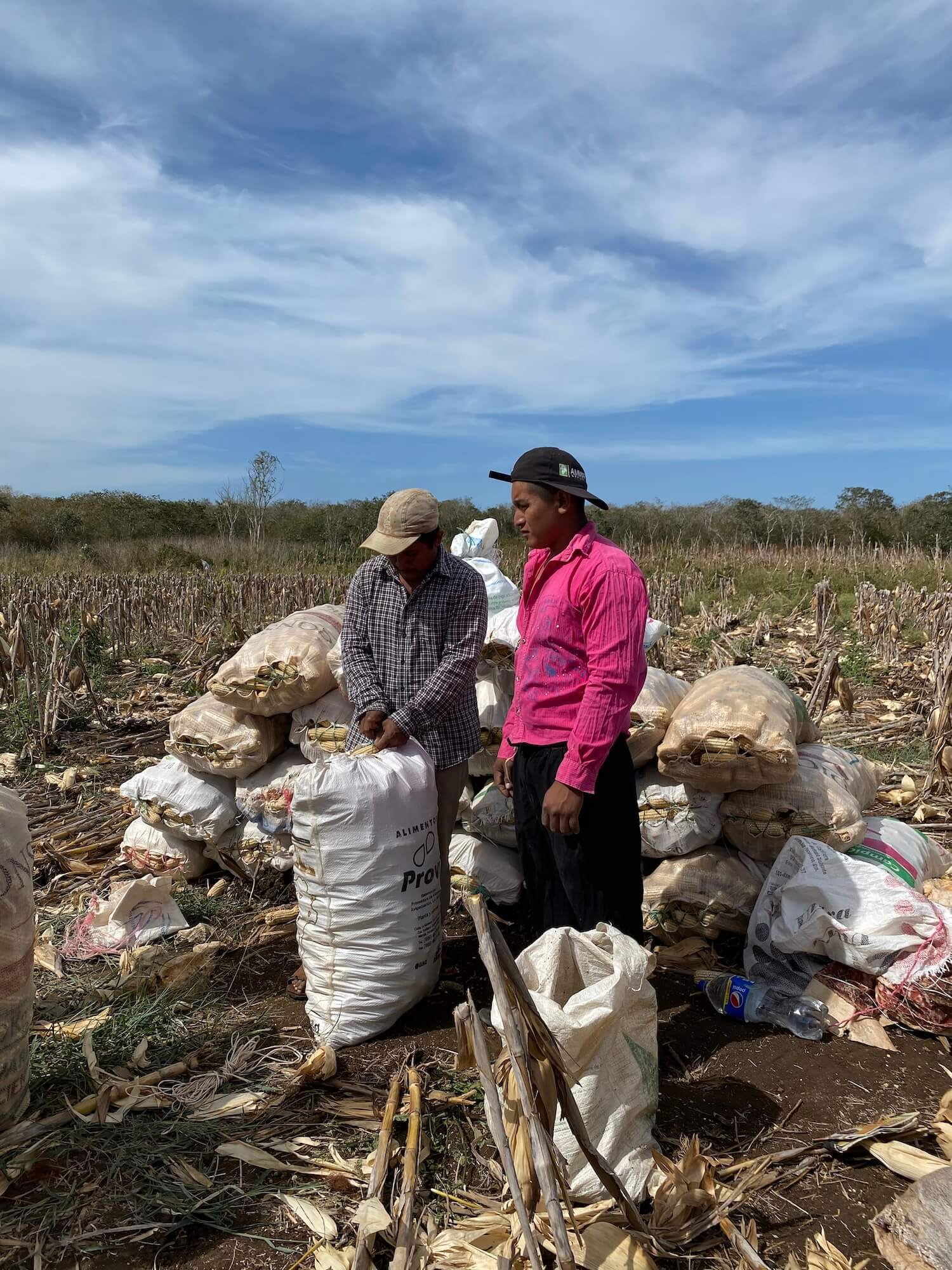
Campesinos harvesting corn in Yucatán, Mexico. July 2021

Simran Sethi

Campesinos harvesting corn in Yucatán, Mexico.

The phase-out plan has, indeed, generated pushback, including 17 unsuccessful legal challenges in Mexican courts, mostly from agribusiness interests including the country’s National Farm Council. In an interview with Reuters, National Farm Council spokeswoman Laura Tamayo (who also serves as regional corporate director for Bayer) said, “The lack of access to production options puts us at a disadvantage compared to our competitors, such as corn farmers in the United States.”

Leticia López Zepeda, executive director of the autonomous cooperative of small- and medium-sized commercial grain farmers known as ANEC, conceded that an overhaul of Mexican agriculture will take years, if not decades. “Finding a substitution for glyphosate is incredibly challenging. It’s like an addiction: an alternative must be formed in order to satisfy [farmers’] needs.” Nevertheless, she said, “Campesinos [local farmers] have the tools and resources they need, and are excited to return to a traditional farming culture.”

López Zepeda suggested that her cooperative’s farmers would rather take on new challenges than work within the system that supports GE corn. In her view, that system is marketed in the name of feeding people, but has failed to do so well: “They try to sell the idea that with transgenic corn, we’re going to provide good nutrition to the world. But we know this is not true because transgenic corn will hold onto and transfer all the glyphosate [to people].”

Although Mexican farmers focus on growing the 25 million tons of white corn used annually to make tortillas and other dietary staples, transgenic corn continues to seep into Mexico’s food supply: indirectly through the consumption of animal protein, and directly through food products such as cornstarch and high fructose corn syrup that allow for GE corn, as well as through informal seed exchanges.  

“Kernels of corn are seeds. Whether it’s for livestock feed or anything else, if a farmer sees them and doesn’t know they are transgenic, he or she might plant them,” Wise explained. “Even though Mexico has banned the cultivation of GM corn [except for limited experimental projects], contamination through cross-pollination with native corn is happening, inadvertently, from whatever corn is being imported from the United States.”

Although full details of the plan have not been released, Wise said “sustainable and culturally appropriate” alternatives to glyphosate are being actively developed. “An experimental trial in the heart of industrial maize country, where the biggest farms are, shows that, by employing a series of biofertilization and biopesticide applications as a substitute for glyphosate, [farmers] could get comparable yields for much lower costs.” 
Despite uncertainties about how transgenes from GE corn or alternatives to glyphosate might impact native crops and reshape domestic agriculture, one thing is certain, said Mauricio Bellon, human ecologist and research professor at Arizona State University’s Swette Center for Sustainable Food Systems: “The introduction of transgenic varieties is cultural erosion. It threatens the practices and institutions that have been maintained since the crop originated.”

Mexico is the world’s largest, most diverse, and enduring genetic resource for corn, home to nearly 60 corn landraces, plus its wild relative, teosinte. These varieties—which have been preserved through seed saving practices over multiple generations—hold genetic traits that will need to be bred into commercial strains, helping them respond better to threats from pests, disease, and climate change volatility. GE corn poses an existential threat to those heirloom varieties, since intermixing could lead to the expression of patented genes, making them the intellectual property of companies like Bayer. 

“What happens to the farmers’ rights if their crop is contaminated with GM seed?” Bellon asked. “Seed saving could, theoretically, become illegal.” His concerns around the legality of seed saving and sharing are rooted in precedent, evidenced not only in global seed treaties, but in regulations within the United States. 

In addition to sustaining traits that are essential for future breeding, Bellon stressed, Mexico’s centuries-old production and culinary practices reveal a depth of connection that extends well beyond physical nourishment to spiritual and cultural sustenance. Corn is not only a dietary staple. It is an integral part of Mexican land and culture. “The invention of corn by Mexicans,” poet and Nobel Laureate Octavio Paz once said, “is only comparable to the invention of fire by man.”

Despite this unique and integral link to the past, present, and future of corn, not everyone agrees that GE imports endanger Mexico’s crop, or that higher yields will benefit smallholder farmers. As general director of Servicio Nacional de Inspección y Certificación de Semillas, the country’s agency devoted to preserving and certifying local plant varieties, Enriqueta Molina Macías oversaw Mexico’s Plant Variety Protection program. She maintains that genetic modification, and potential genetic contamination, are not what really threatens Mexico’s native corn species: “Genetically modified corn has not been authorized for commercial use. The reduction of the presence of landraces is likely caused by the use of new plant varieties, including hybrids with better yields, higher industrial quality, and greater homogeneity.”  

Singling out GE corn, she said, does not mitigate biodiversity loss, and, in fact, she explained, the government’s order may increase the threat. “The farmers who cultivate native maize are part of our most vulnerable rural population,” she said. “If this maize is considered a commodity under the premise of food self-sufficiency, it will lose its strength as a niche specialty product: its most important [economic] value.” An increase in domestic yields could drive down prices and push local farmers towards cultivating higher yielding varieties. The greatest contributor to the erosion of biodiverse native varieties, she said, is a dearth of policies and support for the mostly subsistence farmers who grow the crop. 

But, according to ANEC’s López Zepeda, the Mexican government is extending support. She pointed to programs implemented under President López Obrador that pay farmers above market prices for their crops and provide financial subsidies during production to farmers working on less than five hectares (roughly 12 acres) of land. Additional government-backed projects teach corn producers how to transition away from glyphosate toward agroecological farming methods and pay rural residents to cultivate agroforestry projects on their property.  


This is a welcome development to food sovereignty and environmental activists on both sides of the border who defend the decree, including a coalition of 80 organizations that signed a letter opposing U.S. interference in Mexico’s phaseout of glyphosate and GE corn. “We call on Secretary Vilsack and Trade Representative Tai, as key leaders in the new administration, to respect Mexico’s decision to protect both public health and the integrity of Mexican farming,” said Kristin Schafer, Executive Director of Pesticide Action Network North America, an organization dedicated to reducing the proliferation of synthetic inputs in the food supply, in a press release. “It is completely unacceptable for U.S. public agencies to be doing the bidding of pesticide corporations like Bayer, who are solely concerned with maintaining their bottom line profits.”

In Mexico, support includes the national movement Sin Maíz, No Hay País (Without Corn There is No Country), which delivered to Mexican authorities a similar letter signed by 335 organizations that urged them “…not to give in to the blackmail of the associations that in their eagerness to maintain their profits and preserve their power have crossed the boundaries of ethics and health, seriously damaging the health, economy, and biodiversity of the Mexican population,” and “…to jointly build a new agri-food and nutritional system model.”

Although President López Obrador is committed to reducing Mexico’s dependence on foreign corn, Wise explained that the ultimate goal is choice. “Self-sufficiency doesn’t mean that every single morsel of food that we eat is grown by our own growers. Food sovereignty means we get to determine where, when, and how we source our food and how we feed our people. And that can be from trade. That’s a choice—how much trade, how much domestic production—a sovereign choice that Mexico should get to make.”

The end objective, López Zepeda added, is to topple the entire corporate agribusiness model before it wipes out agriculture as Mexican farmers know it. She readily admitted the uphill battle, but took heart in the knowledge that the campesinos are struggling in solidarity with many other farmers around the world who also believe in biodiversity. “Globally, we are all fighting to keep GMO corn from being produced. [Bayer and Monsanto] have inhumane views, and they dehumanize nutrition and campesinos. They are enemies of the pueblo. They are enemies of the planet. They are going to go down with the fight that we will continue to give them. We will defend and protect agriculture and keep it pure.”

And while the phase-out has significant trade implications for the United States, Wise said the Biden administration should not only respect Mexico’s right to make change, but consider embracing similar changes. In fact, several U.S. cities including Seattle, Miami, Austin, Los Angeles, Boston, San Francisco, and New York have already limited or banned the use of glyphosate.

“Our soils are depleted, we’re poisoning our waters,” he said. “They should look at the policy and say, ‘Maybe we need to do some of the same kinds of things to support our country.’ We also face environmental and economic crises in rural areas. We need to take steps like that, too.” 


Source: https://thecounter.org/mexico-phaseout-glyphosate-genetically-engineered-corn-united-states/

Kabul and the Survival of the Afghan Heroin Trade


Kit Knightly,
August 17th

 Afghanistan has “fallen”, that’s the line. The Taliban forces have taken the opportunity of US/NATO withdrawal and swept across the entire country, taking every major city within a week and with barely a shot fired.

Joe Biden is being blamed for his “lack of plan”, even as Democrats try and shift the blame to Trump who first decided to pull the US out of Afghanistan over 18 months ago.

Meanwhile, the press are reporting dozens of stories about the humanitarian crises, refugees fleeing the new regime, the fate of women under the Taliban, and “shocking videos” of desperate people.

That’s the official story. But what’s really going on?

1. Did the Taliban really just win?

Firstly, let’s be clear, the US has not “pulled out” of Afghanistan, not in the true sense of the phrase. They still reserve the right to bomb the place. There are still private contractors in the country. And the Pentagon are already booking their return tickets.

Secondly, the Taliban didn’t “win”, they were unopposed. More than unopposed, they were directly aided. When the US abandoned Bagram airbase they left hundreds of armored vehicles, weapons and over 5000 alleged Taliban prisoners…all of which “accidentally” fell into the hands of the advancing Taliban forces.

The Afghan army, under command of US puppet President Ashraf Ghani, essentially folded without a shot being fired. Tens of thousands of US-trained and armed troops did nothing to stop the advance of the enemy.

There are a LOT articles in the MSM endeavouring to explain this. The Guardian. And The Telegraph. The Financial Times. And the non-financial Times. They all give it a go.

The Washington Post’s Max Boot, writing for the Council on Foreign Relations, ties himself in mental knots trying to explain how the Afghan army, with superior numbers AND firepower, “collapsed under pressure”.

The Independent reports that the billions the Pentagon spent on training Afghan security forces has “accidentally” benefited the Taliban, who have now seized vehicles, missiles and aircraft.

The press clearly sees it for what it is – a hole in their story they really need to plug.

All things being equal, the simplest explanation is often the most likely. And the simplest explanation here is that the Afghan security forces were ordered to stand down as part of a deal with the Taliban. There are reports and rumours on social media of deals being done:

And, of course, the exact terms of the peace agreement, signed by Trump and Taliban last year, are not known. But it’s interesting to note that this agreement actually called for a handover of exactly 5000 Taliban prisoners. The same number “accidentally” left unguarded at Bagram Airbase.

One interpretation is that the withdrawal has gone exactly as planned in the deal signed by Trump. And that the melodrama and “chaos” of the pull-out was either a part of the deal, or a later addition to either cause a distraction or save some face.

2. Is the chaos real?

The media have been generating memes to sell the “chaos” of the Taliban’s advance. The go-to comparison has been the fall of Saigon, because the (completely unintentional) “near-identical images” (completely unintentionally) “went viral”.

We’re treated to a lot of viral video footage. Ranging from the questionable:


To the outright bizarre:

All of this serves a purpose, aside from the distraction of emotive metaphors and lurid headlines. It all aids in the construction of a narrative.

In this case, the ideas of US “mistakes” and “incompetence” and “wishful thinking” are discussed at length, without ever touching on the true mendacity at the heart of the Afghan invasion.

The “end” of the Afghan war is being used to re-brand its beginnings. The Taliban are propped up as villains, again, and associated with Al Qaeda, as if they were ever anything but a Western tool in the first place.

People are talking about “spreading democracy” and “counter-terrorism” as if they were the real aims of the war, instead of long-discredited lies.

Marketing Afghanistan as a “defeat” for the US camouflages the truth of it – the war was a VERY profitable business venture.

And, of course, it all serves to reinforce the frail official story of 9/11, a vital keystone in the construction of our geo-political “reality”.

3. What about the heroin?

The press has a long history of, not just lying about Afghan heroin, but totally inverting the truth. In 2019 for example, during the farcical “leak” of the Afghanistan Papers, the press lamented the US’ “failure to curb” the opium trade.

Afghanistan currently produces around 90% of global heroin. When the US invaded in 2001, that number was much closer to zero. The Taliban outlawed the growing of opium poppies in early 2001, and by the end of the year the business was almost extinct.

The US invaded in November 2001, and opium production has increased almost every year since then. We don’t need to go into the CIA’s links to the drug trade here, or how much money people have made from this heroin production. That’s not relevant, what we need to ask is, what now?

Will the newly-reinstated Taliban put an end to this trade again? Or will production continue?

According the press, the heroin will continue to flow. In fact the Taliban will increase production because the “illegal drug trade helps fuel” them.

Reuters reports that the US plan to halt heroin production “failed”, and that the opoium trade is a “boon” for the Taliban.

The Telegraph headlines that “Taliban mulls flooding the West with heroin to shore up Afghan economy”. So we should be prepared for the illegal heroin trade to increase now the US has “withdrawn” from Afghanistan.

But the idea that heroin benefits the Taliban, and the US wants to put an end to it is a myth. Afghan heroin is, and always has been, a US/Deep State/corporate enterprise to the bone.

And, If the Taliban do allow the US to continue to use their land to mass-produce heroin, that is yet another piece of evidence supporting a deal between the Taliban and the West.

4. Will there be any Political Fallout?

So what are the next steps? Where is this going?

Well, in the US, President Joe Biden is experiencing some pretty heavy FLAK. Even his usually-stalwart supporters at CNN ran the headline “Joe Biden is facing a crisis of competence”. Which could mean they’re in the early stages of prepping us for President Kamala Harris.

Geo-politically, the talk is of Russia and China – the only two counties to officially recognise the Taliban government – “stepping into the void”. This is being played as a victory for America’s enemies (and another stick with which to beat Biden), but does that really mean anything?

The Covid “pandemic” has been an eye-opener in terms of conflict between nations. They’ve shown us that, when they really need to, they work together to the same end. They tell the same lies, sell the same stories, and want the same thing. The wall at the back of the theatre has been revealed, in that regard.

The truth is, no matter which nations notionally hold sway in Afghanistan, the profits from the war, the lithium and the heroin will all end up going to the same few pockets. Corporations rule, not countries. Nation-states are no longer the players of the Great Game, they are the pieces. Toys for corporate megaliths. Their owners can make them fight each other, or bump them together and make kissy noises. Each is equally meaningless.

5. Is there another “Refugee Crisis” on the way?

The Afghanistan narrative will fuel other big narratives going forward.

Firstly, there is the coming “refugee crisis”.

The “worst since world war II”, according to Tobias Elwood MP (who can always be relied upon to promote Deep State talking points), which is weird because I’m sure that’s what they said about the refugee crisis in 2016, too. Oh, and in 2019.

The UK’s Defence Secretary has already announced plans to allow Afghan asylum seekers into Britain without passports. Merkel is advocating for similar steps in Germany, and the US press is also on board.

Will these refugees be forced to stay in “quarantine hotels” at their own expense? Have they all been “double jabbed”? We don’t know. Nobody’s thinking about that, that’s from the other narrative. We’re talking about refugees today, Covid can wait.

Anybody opposing asylum seekers entering the country because of Covid will be branded a racist, and medical professionals will claim that “racism is a public health issue more dangerous than covid”, just like they did when the Covid narrative collided with the Black Lives Matter narrative last summer.

That importing asylum seekers, undocumented, from a near-failed state could be suggested at all during an allegedly “deadly pandemic” is a sign of just how contrived both narratives are.

It’s not said much – but corporations love refugees. Just like illegal immigrants, undocumented refugees can be used as cheap labour, with none of the legal protections of full citizens. They can then be blamed for deteriorating living standards, unemployment and wage stagnation. They act as a heat-sink for public anger.

Further, “refugees” with no passports are a great way to get your trained mercenaries, agitators, saboteurs, and/or special forces across national borders without leaving a trail.

The resulting army of undocumented men of fighting age can then serve as a pool of potential “terrorists” who can be “radicalised” at a moments notice and deployed to spread panic at home or abroad.

Which leads us neatly onto…

6. Will we see a major terrorist attack?

It’s only been a few days since the “fall” of Kabul, but already the “renewed terrorism threat” is making waves in the press.

The Sun, in its usual understated style, headlines:

RED ALERT Britain faces ‘direct threat of terrorism’ from Taliban’s Afghan takeover in new wave of terror against West

A rather more sedate report in from AP says: “Concerns over US terror threats rising as Taliban hold grows.”

The New York Times goes almost fully schizophrenic, reporting “A decade ago, a U.S. withdrawal from Iraq opened the door for the Islamic State. Will the withdrawal from Afghanistan do the same for the Taliban? and warning of other terror attacks in the future…

…without ever acknowledging that the US never “withdrew” from Iraq at all. Or that they armed, and trained, ISIS.

Bloomberg warns that “The Taliban are already inspiring terror beyond Afghanistan”. The Times is worried about the “terrorist elite” the Taliban freed from Bagram prison.

Project Syndicate reports that “The world should not ignore the risk that Afghanistan under the Taliban could become a breeding ground for international terrorism.

Politicians from France, the US and UK been eager to talk it up, too:

The former head of NATO has said the West needs to “bolster its terror defences”, whilst the Chairman of the Joint Chiefs has said “terror groups will re-constitute in Afghanistan faster than expected” and the UN is calling for “unity against the global terrorist threat”.

There’s a common theme to some of these dire warnings, too. Tobias Elwood MP (him again), told the Independent:

I would not be surprised if we see another attack on the scale of 9/11, almost to bookend what happened 20 years ago,

Whilst Ivor Roberts, another senior Tory, used the exact same phrase in the Metro, as does this article in The Sun.

All of that in just the last two days.

Does this mean we will see a major terrorist attack?

Maybe, maybe not. We are past due for one, certainly. Major international terrorism, much like the flu, took some time off during the “pandemic.” But, in many ways, the threat is just as effective as the attack itself.

The Covid fear fog is thinning, people are starting to wake up a little, and the people running things need everyone to be afraid.

Conclusion

To sum up the official narrative on US withdrawal from Afghanistan in bullet points:

  • Trump signed a deal with the Taliban, over a year ago, to withdraw from the country and hand over 5000 prisoners.
  • Despite having over a year to plan, the US “withdrawal” was chaotic and messy.
  • The US accidentally left behind weapons, helicopters, ammunition and armoured vehicles, which the Taliban took.
  • The US accidentally left behind 5000 prisoners, whom the Taliban freed.
  • Without US support, the Afghan army, which outnumbers and outguns the Taliban, folded without firing a shot and the Taliban took control of the entire country in less than week.
  • Despite shutting down the heroin trade prior to the US invasion, the Taliban now intend to keep it going, and even increase production.

Do you believe this story? Is it at all believable?

Ignore the sound and fury from the media. The press are like a street magician, if you want to understand what they’re up to you have to look past the hand he’s waving in your face, and look at the one behind his back.

It seems fairly obvious, to me anyway, that US gave weapons and vehicles to the Taliban in exchange for a promise to keep the heroin production going (and maybe access to mineral mines, no word on that yet).

Meanwhile, the “fall out” of the totally manufactured “chaos” is being used to fan the flames of fear-porn. Promoting division over asylum seekers and spreading panic about terrorism.

In short, the Afghanistan story, as related by the mainstream press, is a twisted illogical ball of confusion, intended to provide fuel for future narratives of control.

…which is pretty much true of everything in the news, these days.


Source: https://off-guardian.org/2021/08/17/6-questions-we-need-to-ask-about-afghanistan/

sexta-feira, 13 de agosto de 2021

"I have never lived in a world like this": an MD's testimony


Matt Bettag, MD

August 6, 2021

When did the world become insane? What is the reason for it? Big Brother? Depopulation? Or people in love with control? I don't know and it's driving me nuts. But I've decided I'm tired of complaining about it to my friends and family and I'm willing to put my name on the line. If the woke culture wants to ruin me for speaking the truth, I guess I might as well just get it over with now.

I have been a physician for 24 years, a practicing ENT for 19 years. I have never before seen the medical establishment just stop thinking. Insanity is the new rule, and common sense cannot even be discussed.

From the beginning, 15 days to flatten the curve, I was shocked. We had never done this before, but perhaps this virus was really bad, so I gave the government the benefit of the doubt.

Then came Fauci. He initially said social distancing didn't work, and masks were largely ineffective. But by late March, he pronounced both masking and social distancing necessary. Weird...red flag. But what really hit me was that he went on to say people should use Tinder and Grindr at their own discretion. What? How do you socially distance that? So now I am alarmed.

I started researching the utility of masks. There were very good articles I found — one out of a respiratory center in Chicago, and another a good dental review. I bookmarked both of them. Less than a month later, the dental website was down, replaced by a text saying basically that their information is now irrelevant because of COVID. The Chicago article also had a disclaimer that previously wasn't there saying people shouldn't use their article politically. What? Don't use a scientifically-derived article to make a scientifically based decision on the utility of masks? What the hell is going on?

Next comes PCR. Let's conveniently jack up the cycles to 40+, resulting in a 90–97% false-positive rate, then let's start testing all elective surgery, asymptomatic exposures, and hospitalized patients. In addition, we will reimburse hospitals greatly for COVID admissions and ICU visits. Oxygen doesn't work; go home until you get worse. Oh, and bring your family and friends with you; they'll need testing.

Steroids were advised against early on, which makes no sense because they do decrease inflammation and in ENT have been used widely for viral illness. Next, we find a few weeks later the secret drug to treat COVID: steroids. What?

HCQ, not safe. Has been used for decades worldwide with a great safety profile, but not anymore, because orange man bad. Mention it, and you are a lunatic. The same went for any other proven therapeutic, such as ivermectin and vitamin D.

Vaccines? I wouldn't trust anything the president made. That was Kamala Harris back in the fall. Now if you don't get vaccinated, you don't care about other people, and you wanna watch people die. Oh, and by the way, we should vaccinate everyone, including those who previously had COVID, pregnant women, and small children.

What about VAERS? That's the open record report system that the CDC has made almost unnavigable. It's slowly crept up and showed up to 12,000 deaths coincident with the vaccine. Then dropped to 6,000, only to come back up to 10,000 and now back to 12,000. Just a little glitch from our trustworthy government. There are reports that the numbers could be ten times or more as high, and perhaps the CDC is misclassifying deaths to hide them. But let's trust the government; they've been so good thus far.

Now the latest, the delta variant, is surging because of the unvaccinated. Ignore the data from other countries that have very high vaccine rates but high spiking cases, and ignore the data from other countries that have low vaccine rates and almost no COVID. As a matter of fact, let's not even look at Sweden, which essentially didn't do lockdowns or masking, has a low vaccination rate, and has almost zero COVID.

I have never lived in a world like this, where open medical dialogue is completely suppressed and there is only one party line. I thought the left was always talking about how we shouldn't bully people, and we need to have "dialogue." Well...let's start. The media and the government need to do their job and start opening dialogue to the other side. If we are crazy, it will come out. If we are right, and the data show that to be the fact, then a large apology is warranted.


 Source: https://www.americanthinker.com/blog/2021/08/medical_insanity_as_described_by_an_md.html

quinta-feira, 12 de agosto de 2021

The Vaccine Information War: who is really winning?


Jon Rappoport,   


I don’t believe governments are telling the truth about how many people have taken the COVID shot. I think they’re lying. Inflating the numbers because they’re desperate; far more people than advertised are refusing the vaxx.

In every war, spies and other hired hands try to demoralize the enemy. This is standard operating procedure. Inflating key numbers is one strategy.

In this vaccine war, the ace in the hole is obvious: if enough people say NO to the shot, it’s over. A tidal wave will engulf the governments and their corporate allies.

If people believed, say, that only 30 percent of Americans have taken the shot, and that number is holding steady, despite all the new mandates, morale would shoot up to a new high.

It always feels better to be on a winning side.

If most Americans knew that massive anti-vaxx protests are taking place in France and Germany and other countries, their attitude would shift. If most Americans knew that in Australia, the most fascist pro-vaxx government in the world is sweating bullets, because despite horrendous lockdowns and vaccine mandates, despite cops and soldiers on the streets, Aussies are still going to the beach…that knowledge would bolster spirits.

If people opposed to the vaccine and/or the mandates could get an accurate count on how many posts and how many videos and how many accounts have been censored by social media, worldwide, because those posts express opposition to the vaxx…people would see how large the resistance really is.

Here’s a report from statista.com: “As of August 1, 2021, China had administered about 1.67 billion doses of coronavirus COVID-19 vaccine, whereas about 4.18 billion doses of the vaccine had been applied worldwide.

I don’t believe it. I don’t think the global organization and the logistics are that good. People who’ve traveled extensively know how diverse and spread-out the global landscape is. They know how inefficient many, many governments are.

The world isn’t one huge well-lit modern pharmacy with people lined up and techs administering the jabs.

As several people have pointed out, the unvaccinated are a control group in this vast COVID vaccine experiment. If a year from now, millions and millions of us who didn’t take the shot are obviously still healthy, that’s not going to sit well with the vaccinators-in-charge or the pro-vaccine crowd.

They don’t want a vibrant control group. They want compliant robots.

Then there is this, from Stat News, July 21:

Millions of unused Covid-19 vaccines are set to go to waste as demand dwindles across the United States and doses likely expire this summer, according to public health officials…

Currently, states have administered 52.36 million fewer doses than have been distributed to them, according to federal data.

A significant tranche of Pfizer doses is expected to expire in August… Given waning domestic vaccine demand, those doses are unlikely to be fully used before they must be tossed.

’We’re seeing demand [for the vaccine] falling off across all the states,’ said Marcus Plescia, chief medical officer at the Association of State and Territorial Health Officials.

So which sets of statistics should we believe? Those that pump up the numbers of people who’ve taken the shots, or those that show millions of vials going to waste? I think the latter stats are the true indicators. Officials are less likely to confess to them, unless they’re accurate.

Out in front, the movie called COVID VACCINE is being hailed as a brilliant blockbuster, but at the back end, ticket sales are dropping off a cliff.

There are reasons for that. One is: People are having very serious and severe injuries from the shot; they’re dying; and their families and friends know about it.

Here are the latest CDC figures I have, as compiled by Children’s Health Defense. The statistics are taken from VAERS, the federal Vaccine Adverse Event Reporting System.VAERS data released today by the CDC showed a total of 463,457 reports of adverse events from all age groups following COVID vaccines, including 10,991 deaths and 48,385 serious injuries between Dec. 14, 2020 and July 9, 2021.

Keep in mind there is vast underreporting of injuries, because most Americans don’t know what VAERS is or are hesitant to make a report.

Some analysts have suggested that, to get a reasonably accurate count, you should multiply reported numbers by 10.

The well-known 2010 Harvard Pilgrim Health Care, Inc. study of VAERS bluntly stated: “Adverse events from vaccines are common but underreported, with less than one percent reported to the Food and Drug Administration (FDA). Low reporting rates preclude or delay the identification of ‘problem’ vaccines, potentially endangering the health of the public.

Following the finding of that study, you would multiply the number of reported vaccine injuries by 100 to arrive at a proper figure.

The numbers of vaccine injuries and deaths are huge. In any situation other than the current fake pandemic, the vaccination program would have been stopped. Cancelled.

No matter what governments and news parrots say about the vaccine (“safe and effective”), vast numbers of injured people, their families, and the families of those who’ve died from the shot are messengers for the truth.

The truth spreads.

In a war, when combatants and civilians end up in hospitals, and when many of them lie in coffins lowered into the ground, and when the people can no longer hold a coherent story in their minds about why the war is being fought, the whole mood of a country changes.

This is no time for surrendering or joining those who claim doom is the only outcome.


Source: https://blog.nomorefakenews.com/2021/08/03/the-vaccine-war-who-really-has-the-upper-hand/


quarta-feira, 28 de julho de 2021

¿Exceso de Mortalidad en 2020? (Estudio de Oxford)


NOTA de Contra el Encierro: Estudio estadístico publicado el 3 de Marzo del 2021 por el Centro para la Medicina basada en Evidencias de la Universidad de Oxford. Es un estudio para la comparación por países del aumento de su mortalidad en el año 2020. Además de la normalización según el número de habitantes, se hace una estandarización teniendo en cuenta la distribución por edades de la población y su tasa de mortalidad de los últimos 5 años. Es un estudio muy claro y revelador, además de que pone a disposición pública un sitio web para ver las tablas y los gráficos de este estudio país por país. Lo que no hacen los autores del estudio (que son muy prudentes en la redacción), lo hacemos nosotros remarcando lo que la estadística dice sobre Suecia en comparación con otros países:


   - Suecia es el contraejemplo que demuestra que el esceso de mortalidad NO ESTÁ relacionado con "las muertes Covid", ni por tanto, con ningún virus (puesto que ese supuesto virus, ronda, según ellos, de la misma manera por Suecia que, por ejemplo, por España).
   - El aumento de mortalidad en España en el 2020 es 8 veces mayor que en Suecia. Lo mismo que en Bélgica y USA. En Inglaterra es 7 veces mayor que en Suecia. En Chile y Polonia es 9 veces mayor. En Portugal (encierro más suave) el aumento de mortalidad es 4 veces mayor que en Suecia.
   - Era mentira lo que decían del virus asesino y de la necesidad de atormentarnos. Suecia no lo ha hecho y no ha pasado nada. Era mentira que en Suecia iban a morir masivamente por la osadía de no aplicar estas medidas brutales nunca vistas que se las han sacado de la manga (o sea, de sus planificaciones mundiales de emergencia). ERA MENTIRA. ES MENTIRA
 

                                                           *** 

El Coronavirus (SARS-nCOV2) ha provocado un notable aumento de las muertes en todo el mundo, pero con una importante variación entre países. Parte de esta variación puede esplicarse por las diferencias en la forma en que los países atribuyen la causa de la muerte. Este sesgo puede superarse comparando el esceso de muertes por todas las causas, que es una medida más objetiva. Además, las estimaciones del esceso de muertes pueden ayudarnos a comprender no sólo las muertes que se atribuyen directamente al COVID-19, sino también las causadas indirectamente (daños colaterales).

El esceso total de mortalidad también dependerá de la estructura de edad de una población. Los países con una estructura de edad más envejecida esperimentarán una mayor mortalidad que un país con una estructura de edad más joven. Al estandarizar las estructuras de edad, podemos hacer comparaciones más adecuadas.

Muchos de los primeros informes en los que se comparaba el esceso de muertes resultante de la pandemia de COVID-19 no tenían en cuenta el tamaño de la población ni la distribución por edades y se centraban principalmente en la primera fase de la pandemia. Aquí, damos estimaciones actualizadas de las tasas de esceso de mortalidad general en el 2020, estandarizadas a una población de referencia.

Métodos

Los datos de mortalidad semanal de 37 países se obtuvieron de la serie de datos de Fluctuaciones de Mortalidad a Corto Plazo (STMF) en la Human Mortality Database (HMD). Calculamos la mortalidad esperada para cada país tomando la media de los últimos 5 años (2015-2019). Hemos calculado las tasas de esceso de mortalidad ajustadas por edad y por sexo estandarizando según la población estándar europea (2013), utilizando los grupos de edad de (0-14, 15-64, 65-74,75-84,85+). Los datos se presentan como mortalidad total estandarizada por edad por 100.000, esceso de mortalidad total estandarizada por edad por 100.000 y aumento porcentual de la mortalidad por 100.000 ajustado por edad. Los aumentos relativos son útiles cuando se comparan países con marcadas diferencias en las tasas de mortalidad anual.

Costruimos una aplicación web que permite al usuario hacer gráficas y tablas para las estadísticas de esceso de mortalidad de cada país utilizando un promedio de los datos de los 5 años anteriores. En la tabla siguiente resumimos los datos de la mortalidad estandarizada por edad para el año 2020 calculando la mortalidad estandarizada por edad esperada, utilizando una media de los datos de los 5 años anteriores cuando es posible, y la media de los 4 años en los que no se disponía de esos datos (Chile, Alemania y Grecia), utilizando una aplicación web alternativa que hemos hecho nosotros.

Aquí puede accederse a la aplicación Esceso de mortalidad por semana en el 2020.

Country
Mortalidad esperada estandarizada por edad en 2020 (por 100.000)
Mortalidad estandarizada por edad total en 2020 (por 100.000)
Esceso de mortalidad estandarizada por edad en 2020 (por 100.000)
Porcentaje de aumento de mortalidad estandarizada por edad por 100.000
Austria 938 1009 71 7.6%
Bélgica 956 1072 116 12.2%
Bulgaria 1597 1788 191 12.0%
Canada 709 751 42 6.0%
Chile* 1041 1184 143 13.8%
Chequia 1147 1258 111 9.7%
Dinamarca 1016 972 -44 -4.3%
Inglaterra & Gales 960 1060 100 10.5%
Estonia 1178 1178 0 0%
Finlandia 948 919 -29 -3.1%
Francia 839 895 56 6.7%
Alemania* 1016 1049 33 3.3%
Grecia* 912 957 45 4.9%
Hungría 1420 1473 53 3.7%
Islandia 755 724 -31 -4.1%
Israel 864 920 56 6.5%
Italia 728 792 63 8.7
Letonia 1446 1414 -32 -2.2%
Lituania 1393 1468 75 5.4%
Luxemburgo 842 852 9.5 1.1%
Países Bajos 971 1040 70 7.2%
Noruega 893 861 -32 -3.6%
Polonia 1216 1391 175 14.4%
Portugal 977 1043 66 6.8%
Escocia 1134 1219 85 7.5%
Eslovaquia 1219 1236 17 1.4%
Eslovenia 996 1116 120 12.0%
Corea del Sur 779 757 -22 -2.9%
España 838 946 108 12.9%
Suecia 883 896 13 1.5%
Suiza 783 817 34 4.3%
USA 1020 1152 132 12.9%

Canadá sólo tiene datos hasta la semana 42, e Islandia e Italia hasta la semana 44. Eslovaquia sólo dispone de datos hasta la semana 48, y Grecia y Corea del Sur hasta la semana 49. Suiza y Chequia estan basados en datos hasta la semana 50, y Hungría, Eslovenia y Estados Unidos en datos hasta la semana 51.

Osservaciones

El esceso de mortalidad relativa en los países que hemos essaminado oscila entre el -4,3% y el 14,4% y está fuertemente correlacionado de forma positiva con el número de muertes COVID-19 registrado (r = 0,8). Dinamarca, Finlandia, Islandia, Letonia y Noruega esperimentaron menos muertes en 2020 según nuestro análisis. Como era de esperar, estos países han registrado un número menor de muertes por COVID-19 que otros países. Por ejemplo, Islandia, Noruega y Finlandia han registrado menos de 12 muertes por cada 100k de COVID-19. Dinamarca y Letonia son quizás las escepciones, ya que han registrado 32 muertes por COVID-19 por cada 100k y Letonia 54 por cada 100k.

Varios países de Europa del Este apenas registraron un esceso de muertes en la primera mitad del año, pero han esperimentado un importante esceso de mortalidad en la segunda mitad de 2020. Bulgaria, Chequia, Croacia, Hungría, Lituania, Luxemburgo, Polonia, Eslovaquia y Eslovenia, con Polonia y Bulgaria mostrando niveles de esceso de mortalidad del mismo orden de magnitud que los países en el centro de la primera ola (por ejemplo, España, Francia, Inglaterra y Gales, Italia).

Estados Unidos, que a menudo se ha citado como el país más afectado (a menudo utilizando el número total de muertes de COVID-19), tiene un esceso relativo del 12,9% que, aunque es uno de los más altos, está por debajo de algunos con un esceso de mortalidad relativa aún mayor, como Polonia y Chile.

El esceso de mortalidad relativa estandarizada es un método para medir el impacto de la pandemia de SARS-nCOV2. Es mejor que la comparación del número total de muertes por COVID-19 y podría decirse que es más útil que la comparación de la tasa de mortalidad por COVID-19 por cada 100.000 habitantes, ya que supera el sesgo de registro y mide tanto las consecuencias directas como las indirectas de la pandemia. Pero tiene limitaciones. Hemos observado que la definición del número esperado de muertes y, por tanto, del esceso, puede variar según se utilice una media de cuatro o cinco años. Además, el uso de promedios simples de datos históricos de mortalidad podría subestimar si hay una tendencia significativa a la baja en la mortalidad o sobreestimar si hay tendencias al alza.

Artículo del 3 de Marzo del 2021 publicado por el Centro para la Medicina basada en Evidencias de la Universidad de Oxford por Ufuk Parildar, Rafael Perera y Jason Oke.


Nota de Contra el Encierro


Se ve la prudencia de redacción durante todo el artículo para no decir algunas cosas todo lo claramente posible y otras veces, incluso, diciendo cosas que no son ciertas. Por ejemplo, la primera frase del artículo "El Coronavirus (SARS-nCOV2) ha provocado un notable aumento de las muertes en todo el mundo, pero con una importante variación entre países", es ya en sí misma falsa (como se ve en el contenido del mismo).

El gran servicio que le pueden prestar las estadísticas bien hechas a la gente es contradecir las afirmaciones y la doctrina falsa que los mass-media y los gobiernos crean sin parar. Esta estadística hace eso. Por ejemplo, lo hace muy claramente si se resaltara el caso de Suecia, que en las osservaciones se pasa por alto (cuando todo el que está atento a echar luz sobre esto está esperándolas). 


FUENTE:

https://contraelencierro.blogspot.com/2021/03/universidad-de-oxford-esceso-de.html